Thursday, September 28, 2023

Confusing Democracy with Capitalism

I did not watch the September 27 Republican presidential debate.  I did see some of the discussion afterward.  Former Chair of the Republican National Committee, Michael Steele, called the debate a "crap show."  The clips I saw showed the candidates behaving like pre-adolescents.

Rachel Maddow advanced a very perceptive theory that a large segment of the American electorate has decided democracy does not work.  Having lost the popular vote in seven of the last eight presidential elections, and becoming a clear ideological minority, Republicans seem to want to abandon democracy,  said Rachel,  in favor of a strong man who will put in place the values and policies this segment desires and believes in, even if it must be imposed by force.

Someone else, I cannot remember which panel member, said something that  has churned in my mind for the last 14 hours.  The comment was made that this was because democracy is not helping people pay for groceries, put gas in their tank, or a roof over their heads.

OK, as a philosopher, that struck me bluntly because that statement is an example of what is called a category mistake.  A category mistake is simply what it sounds like.  It is when we attribute something to one category when it belongs to another.  It is like talking about the color seven or the number blue.

In this instance, the category mistake is one of attributing to democracy, one category, the failures of another category, capitalism.

Disclaimer here, I am decidedly anti-capitalist.  I have read over 1000 pages of the works of Karl Marx, and I think he is misunderstood.  I do not think what the Soviet system gave the world is Marxism.  I believe Lenin and Stalin appropriated and appealed to Marx even though what they were offering was not at all what Marx advocated.  In this case, I believe Lenin and Stalin have distorted the message of Marx the same way evangelicals and nationalists have distorted the message of Jesus.  (I adamantly refuse to use the term "Christian nationalism" because I do not consider that view point, nor its adherents, to be anything remotely Christian.)

My reading of Marx is that the single most important thing about what he said is what he calls surplus value.  I am quoting now, the highlighted section, from a piece of mine which can be found here.

In Marx's day the average workday in a factory was 12 hours. And after roughly 6 hours, a worker had produced enough value to cover their own wages and the production costs for what work they did, for the entire day. So for the remaining six hours the worker worked solely for the enrichment of the capitalist. This is why he suggested that in capitalism the worker is a tool. I think he was correct. And one result of this is, the more productive a worker is, the less per unit the labor cost to the employer. Marx called this "surplus value," which is not totally identical to, but is roughly equivalent to, profit. By the time profits are made, that is free money to the capitalist. The capitalist, said Marx, never pays anything at all for labor because the productivity of the laborer pays the cost of labor. I think the entirety of what bothered Marx could be boiled down to this idea of "surplus value."

The category mistake is to blame democracy for the failure of capitalism. I believe in one sense capitalism is a failure, but in another it is a huge success. The success is what I describe above, capitalism has made the capitalist rich while keeping the worker in a place of economic submission. I think today's workers are viewed as economic serfs. When Sen. Tim Scott said the other day that striking workers should be fired, that is a form of serfdom. In this sense, capitalism has succeeded because its goal is to make as much profit as possible with as little expenditure on things like labor as necessary. The charts below demonstrate how "trickle-down" economics has worked in this regard. Beginning with Ronald Reagan, the goal, which it meant to achieve, has succeeded. The chart below shows how productivity has increased but wages have not. This chart demonstrates what Marx called surplus value.
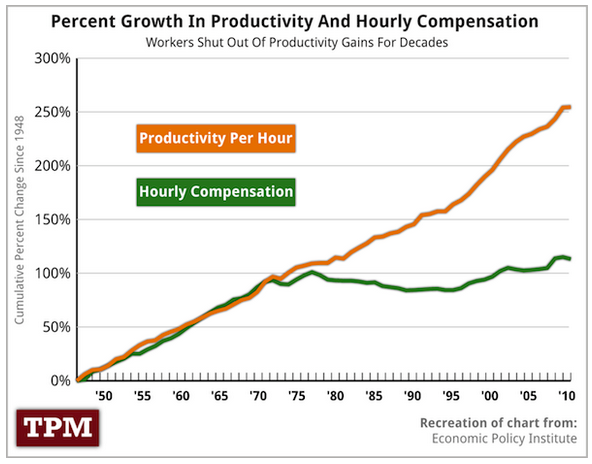

This chart shows how, from about the time of Ronald Reagan, the wealthy have gotten exorbitantly wealthier and everyone else has stayed about where they were.


If wealth really "trickled down" the red line would be getting closer to the blue line instead of farther from it.

In another sense, capitalism has failed. It claims to be the most efficient means of broadly distributing wealth. But in this sense, I believe the very existence of billionaires is exhibit one in the argument that capitalism is a failure.

Now, the category mistake is this: Blaming democracy for the failures of capitalism. You can have democracy with or without capitalism. What Marx advocated was more democratic than anything I know of. And I would suggest if you want to look at whether it works or not, look not at the failed Soviet system, but look at the Scandinavian countries. Very democratic, yet rooted in a socialistic economy which is designed to work for everyone rather than just the wealthy. And by the way, even Forbes Magazine says the Scandinavian countries are among the best places to put a business, for these reasons.

So you can have democracy with our without capitalism. I think capitalism is in some ways anti-democratic. But I would say to MSNBC and all other outlets, please do not make the category mistake of blaming democracy for capitalism's failures.


Saturday, September 23, 2023

Pastoral Counseling vs. Mental Health Counseling

I want to thank my dear friend, Christian sister, and fellow Parkinson's patient Julie Nichols, for the exchange of ideas which led to this post.

I have the benefit of one of the best seminary educations a pastor could have.  I  began my studies at the Earlham School of Religion, a Quaker seminary.  Then I transferred and finished my MA degree at The Southern Baptist Theological Seminary in Louisville, KY.  (This was back in the days when Southern Seminary was a real seminary and not the fundamentalist indoctrination mill it is now.)  I did my Doctor of Ministry in Theological Reflection at Bethel Theological Seminary in St. Paul, MN.  I am old, all of that happened in the 20th century.  I tell people I grew up Baptist, went to Quaker seminary, transferred to a Baptist seminary and became a Quaker pastor!   (And now I am Roman Catholic!)

While at Southern Seminary I majored in Adult Religious Education, but realizing I would probably have to work as a generalist instead of a specialist, in addition to about 12 hours of educational psychology I took 9 hours of the psychology of religion and pastoral care.  My two professors for those classes, were considered, nationally, to be at the apex of that field, Wayne E.  Oates and Andrew D. Lester.  Dr. Oates is considered by many to be the father of the field of the psychology of religion.


The Struggle to be Free is his memoir.  But in his class we read another of his classic books, The Christian Pastor.


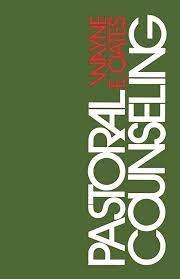
Wayne taught us that the role of a pastor in counseling is difficult to navigate.  He also wrote the book on Pastoral Counseling.  He taught us that pastors can give useful counsel on things like Christian discipleship but to stay away from mental health counseling.   He said that at best, the pastor's role in mental health is what he called "the ministry of referral."  Even most seminary-trained pastors, those with outstanding educational backgrounds (like myself) are simply not equipped to do mental health counseling.  Most pastors are not capable of doing that work, and even if they are, they should NOT even attempt to do that work with their own congregants, for reasons I will cite below.  It is as irresponsible for a pastor to provide mental health counseling as it would be for a pastor to perform your appendectomy.  It is an abuse of the pastoral role.


It is pastoral malpractice to do therapy on one of your congregants for the following reasons.

Most pastors are not equipped to do professional counseling.  

I mentioned that I took educational psychology as well as the psychology of religion.  When I began teaching at a community college two decades ago, I taught Introduction to Psychology and Lifespan Development. My background served me well to teach these lower-level courses, but eventually the philosophy department grew to the point where I only taught philosophy.  But one semester I was asked to teach Abnormal Psychology and I adamantly refused, because I knew I would be in over my head and it would do the students a great disservice.  And I think if I was not in a position to deal with issues of psychological maladaptation, neither were my pastoral colleagues in a  denomination where seminary was not even a requirement to be a pastor.  

Knowledge of the Bible does not help one counsel.

The Bible is wonderful.  Nobody on earth loves the Bible more than me.  I have been studying the Bible for 49 years.  I have read scripture daily for almost 18,000 consecutive days.  But the Bible is not inerrant, and does not address modern-day issues of mental health.  While there are valuable Biblical principles, knowing the Bible does not prepare one to do therapy any more than it prepares one to do surgery.

I cannot overemphasize this point because I have seen first hand the harm done by pastors who are not sufficiently trained, but because they have "Rev." in front of their name, people think they are able to help in situations where, honestly, they are not. In fact, they are more likely to do harm than help.  I know of one situation where a pastor is facing possible criminal charges because he presented himself as having expertise he did not have, and a congregant who followed his counsel was done great harm.  I believe it is morally and professionally irresponsible for a seminary graduate to presume to treat mental health issues, let alone someone who just opens a Bible and starts preaching.  (I will admit some bias here, I have always RESENTED people who presume to be preaching with no formal theological training.  It took me 15 years to earn two seminary degrees, because of some breaks I took along the way.  When I was "recorded" (Quaker lingo for ordination) even though I did not have my master's yet, I had spent more time in a seminary classroom than anyone on my committee!

It is simply inappropriate, professionally, for pastors to do mental health work with a congregant.

I mentioned above the situation where a pastor misrepresented himself.  But even if he had the credentials he said he had, in no way should he ever have been counseling a congregant.

I have a friend who I have known for 35 years who is a Quaker minister and a retired family and marriage therapist.  But when she was a part-time pastor, she did not perform counseling services for congregants.  I know one of his congregants thought this was not good, thinking she should offer her services to congregants for free.   This is a bad idea for at least two reasons:

1.  It takes advantage of her training.  You would not expect a lawyer or a physician to do pro bono work just because they go to your church.  It is not fair, if the pastor happens to be a trained therapist, to ask them to do that.

2.  It creates a huge problem known as dual relationships.  Dual relationships are a disaster.  My son is a successful physician, and a regional medical director over several clinics.  But when we ask him medical questions, he keeps the information on a basic level, making sure we remember he is our son, not our doctor. He is 100%  correct to do that.

Dual relationships are situations where two parties are related in ways in which a problem in one of the relationships will create problems in the other.  I always worked hard to avoid dual relationships.  I had a congregant get angry with me one time because when I purchased a new clothes dryer I did it from another store instead of his. But my thinking was, and I have seen this play out, if there is some dispute about the purchase it could adversely affect my pastoral relationship with this person.  More than once I have disappointed people by making these choices, but I still think I did the right thing.  In fact, I encouraged my congregations NOT to do business with one another because it can become ingrown instead of bringing your witness into contact with other people.  Most people did not see why I did this, but to me it was ethically required of me.

Even if a pastor is a certified therapist, psychologist, or psychiatrist, I would encourage them to negotiate with their faith community that those services not be included in the pastoral services they provide.  I would encourage pastors to decline to get involved beyond making a referral because of the particular dangers and pitfalls which can harm the pastoral ministry.


Tuesday, September 19, 2023

A Different Take on Cheap Grace

 A conversation ensued from a comment I made on Facebook this morning:


I'm going to say something controversial. That is something I have a tendency to do. Someone recently told me that it was a sin for someone to hope at another person does not in the end receive God's redemption. My problem with that is this. I think that does not do justice to the pain of people who have been terribly victimized. It disregards and disrespects what they've been through. And even if what that person said is correct, it is terribly insensitive to tell someone that who has been terribly wounded.


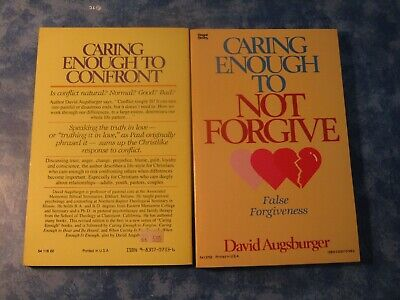
In the conversation which followed, I was reminded by a dear friend that we have had a tendency to offer grace in a shallow, superficial way which I believe has done more harm than good.  It reminded me of the two books by Myron Augsberger, Caring Enough to Forgive and Caring Enough to Not Forgive.  I read these two books, which are actually in one volume, as a confused seminary student in the throes of religious abuse.  The title, Caring Enough to Not Forgive, startled me because in my evangelical upbringing, not forgiving was tantamount to sin.


What I found rang true with me though.  Augsberger was saying if we forgive before we "process our pain" (to use the phrase of my good friend James R. Newby), we short-circuit true forgiveness and end up sweeping things under the rug and do ourselves harm.

My mind then went to Dietrich Bonhoeffer and his exquisite phrase, "cheap grace."


I believe Bonhoeffer is right about how the church has offered cheap grace.  It has resulted in people who claim to be Christian but do not want to, as he put it, pay the Cost of Discipleship.  My mentor, Elton Trueblood, was getting at something similar with his book, The Company of the Committed.  I believe cheap grace has harmed the church.


But this morning I am thinking about another kind of cheap grace.  I think when we push people to forgive before they can process their pain, the grace they end up giving the offender is far too cheap.  I think not only has the church "sold grace on the market like cheapjacks wares,"  but the church has encouraged people to sell their own selves or their psyche as a cheapjacks ware.  When we push people to forgive before they are ready, they end up with a cheapened view of themselves. If the grace people give is seen by them as too cheap, the person ends up feeling cheapened.

I replied to my friend this morning:

When we make it too easy, in the end we end up with a different kind of cheap grace. I know that is not what Bonhoeffer meant by the phrase cheap grace, but if we make the grace we offer others too cheap, then it is kind of like prostituting ourselves. We sell ourselves too cheaply and harm is done.


God only knows the harm we have caused by pushing people to offer cheap grace and end up with a cheapened self.  I think this harm is at least as harmful as not forgiving at all.    


Thursday, September 14, 2023

The word "Republic" is a dirty word!


In the year 1787, as he was leaving the Constitutional Convention, the legend is told that Benjamin Franklin was asked by a woman what kind of government the convention was giving us.  His reply, "A republic, madam, if you can keep it."

I have recently retired after almost 20 years of teaching philosophy to college freshmen and sophomores.  In my Introduction to Philosophy class, each week we read one of the dialogues of Plato. In Introduction to Ethics, we read a book of Aristotle's Nicomachean Ethics.  I had my students doing this reading because I am committed to the use of primary sources.  But I did it with the realization that I did not agree on many things with either of these two great Greek minds.  In Aristotle's case, it is not difficult to detect traces of classism.  His elitist upbringing in the royal court--as son of the royal physician of the king of Macedonia--colors his view even of his virtue ethics.  I like virtue ethics, but I do think that their applicability is not well suited to persons who have not had the advantages in life Aristotle himself had.

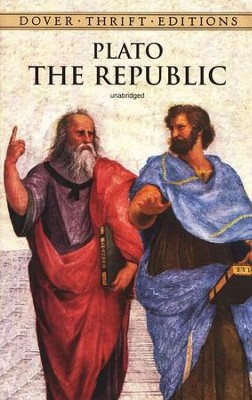
Similarly, Plato was also an elitist.  His idea of a republic was one in which society was governed by the intellectual elite.  He thought that artisans, guardians, and philosopher-kings were distinct classes in a society and that the philosopher-kings should make all the important decisions.  He said that these philosopher-kings should do so making sure they look out for everyone's interests, however.  When my wife learned that Plato thought society should be governed only by professional philosophers, her response was something like, "I am married to one.  I think that is a horrible idea."

Now Plato did have a couple of ideas in his concept of a Republic which I like.  He said that those who govern should not own private property because of the tendency of wealth to corrupt people.  I think if one had to liquidate their assets and put the proceeds  in a totally blind trust, to even run for office, we would get better government.  He also said that the structure of society was not static, that artisans and guardians should be able to become philosopher-kings through education and experience.  So he had structure, but not a caste system.

All in all though, I think the idea of a Republic is not a morally legitimate idea at all because it depends, by definition on minority rule, and I do not believe human nature is well-suited for minorities to rule in ways which benefit everyone.   In the case of the United States, I especially think the idea of a Republic is subversive of human freedom and dignity.  I believe there is a significant white supremacist presence in this country which makes it the moral equivalent of pre-apartheid South Africa.

Think about it.  Whoever the "madam" was, that Ben Franklin spoke to that day in 1787, neither he nor any other member of the Constitutional Convention, intended for her, or those who share her gender, nor people of color, nor indigenous persons, to have a share in the decision-making of that Republic.  Minority rule is part of what they intended to give us.  And I do not care if it is big R Republicanism, or little r republicanism,  I think minority rule is exactly what that philosophy wants to see, and the plethora of voter suppression legislation we have seen just since 2020 is exhibit one.

This is not politics, this is morality.  As one of my heroes, New York Times columnist Charles M. Blow, points out, it is impossible to say we had to have time to get to full equality.  The founders knew the people they oppressed or excluded were created in the image of God just as much as they were.  Unlike Plato, the founders did not intend upward mobility unless one was already a white male.  They intended a caste system.

About 15 years ago, I was explaining Plato's Republic in class and I mentioned that the founders wanted only white, male, property owners to be able to vote.  A student said, "That's a great idea!"  I asked why and he said property owners were obviously smarter than non-property owners.  I asked, and he confirmed he owned a home.  At that point, in my mid-40s, I was a bivocational pastor who had lived in either an apartment or rental house or a parsonage my entire adult life.  I had never owned a home at all.  I inquired as to whether he thought that meant I should not be allowed to vote.   He declined answering my question.

I believe big R Republicans are fearful, because, having lost the popular vote in 7 of the last 8  presidential elections, they know the political trendlines are not going in their direction.  Hence, efforts to make it harder to vote.  Big R or little r, I think that republicanism is an assault on freedom and dignity.  The party  which has been supposedly for freedom is now no longer so, because they never really were.  I think they have only wanted freedom for their own tribe.  I believe it is time to completely scuttle the idea of a republic as unworthy of humanity, and replace it with the concept of representative democracy.

Tuesday, September 5, 2023

Book Review: A Liberal, Catholic Defense of Abortion


I promised a review of this book two weeks ago.  People are not kidding when they tell you retirement can be busy!  I apologize for not getting to this sooner,

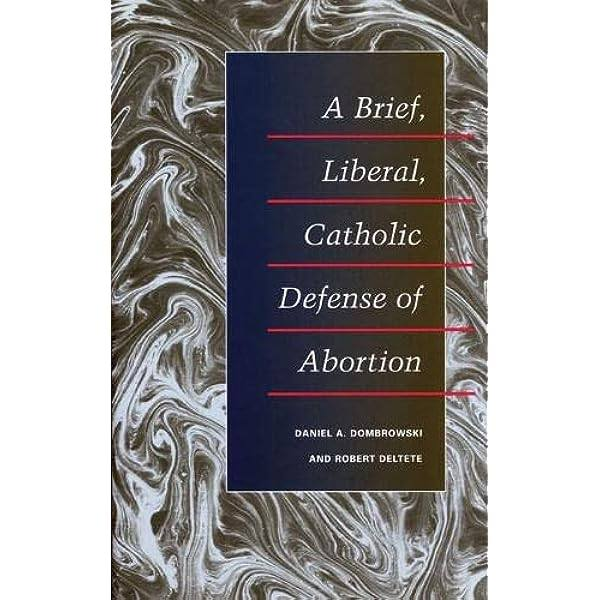
The book is A Liberal, Catholic Defense of Abortion, by Daniel A. Dombrowski and Robert J. Deltete, both professors of philosophy at Seattle University.  Like myself, Dan Dombrowski is not only a Catholic philosopher but also a member of the process philosophy/theology community.

The authors argue that, particularly in Catholicism, abortion has been argued against in two ways.  The first is the perversity view.  This view finds its roots in Augustine, who argued that sexual intercourse is only for procreation.  It is not meant for pleasure and should only be engaged in by married couples for the express purpose of conception.  On this view, abortion is wrong for the same reason contraception is wrong, because it interrupts or interferes with God's purpose in giving us sexual intercourse as part of life.  They cite James McCartney as saying that in essence, the perversity view implies that even if life did not begin at conception, abortion is wrong because it severs the tie between the sex act and its intended purpose.  

Dombrowski and Deltete point out that it is very difficult to separate the Augustinian view from Augustine's own experience as a sexual libertine before he embraced the Christian faith.  I think it is possible that Augustine lets his own experience unnecessarily cloud his theology here.  (And I might ask if we modern-day philosophers and theologians and ethicists do the same.  This is not a slam on Augustine as much as a level of understanding which may put what he said in a broader perspective.)

There are two things which stood out to me about their treatment of the perversity view.  The first is that in essence, Augustine said that because sex is only for procreation, that if a couple enjoys intercourse, even if their only reason for doing it is procreation,  they sin.  I think that is a hideous view which flies against how God made things.  It seems to me if God wanted people to not enjoy sex, God would have made things so sex was not enjoyable.  But of course, if that is the case people would not be having sex, so there would not be much procreating going on.  It befuddles me to base a view of sex on natural law, and then say sex should not be enjoyable, when sex is simply naturally enjoyable.

The second thing is an even bigger deal though.  Augustine said that because sex was meant for procreation only, abortion is evil because it thwarts the purpose God has for sex, even if we do not know when life begins.  Those versed in church history are aware that the Fathers debated when life begins, and were not of one mind about it.  Both Augustine and Aquinas pondered this question in their writings, and neither of them had a definitive answer, even though they both tended toward ensoulment (the point at which human  life begins) happening in the third trimester.  In fact, Augustine suggested that for roughly the first trimester, the life of the fetus is more like vegetative life, and the second trimester like animal life, and the fetus does not approximate human life until the third trimester.

Dombrowski and Deltete reject the perversity view in favor of the more well-rounded view that God also intended intercourse as a means of intimacy, pleasure, and bonding within marriage.

The second view Dombrowski and Deltete discuss is an ontological view. This is the view that hominization, (when the fetus becomes human) occurs early in pregnancy, possibly even at conception.  Both Augustine and Aquinas disagreed with this ontological view.  Their opposition to abortion early in pregnancy could not have been based on an ontological view, for the simple reason that neither of them believed human life began early in pregnancy.

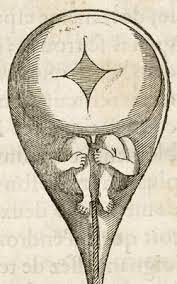
Augustine is writing in the 5th century, and Aquinas in the 13th.  The ontological view  has its roots in the scientific beliefs of the 17th century.  The belief then was that at conception, the human being was totally present, not needing to develop, only to grow.  In the 17th century, Dutch scientist Thomas Hartsoeker depicted this homunucleus like this:


This is what 17th century science thought the zygote looked like at conception.  We now know that is not true.  The modern version of this argument says because human DNA  is present at conception, human life begins at conception.  I discuss the flaws in that reasoning here.  Dombrowski and Deltete then conclude the book with a discussion of why, given what modern science tells us, and given good philosophical reasoning on what modern science tells us, the idea that life begins at conception is not correct, which should give pause to those who adamantly oppose abortion on an ontological view.  It is a serious philosophical mistake to base your position on information, and then continue to hold that view when it turns out the information is false.

I found this book a very worthwhile read.  I am a pro-choice Catholic.  I am an outlier in my faith community in this regard and others.  I think the Catholic church is wrong on abortion, same-sex marriage, just war, and the role of women.  (I fully support the ordination of women.)  

My own view is to the left of Dombrowski and Deltete.  I am opposed to placing any restrictions on abortion at any time, ever. The reason for this is simple. People do not wait until the third trimester to have an abortion because they do not want to have a baby.  People who get third-trimester abortions do so because life and/or well-being of either mother or child is in danger.  I believe  that whenever life begins, and that is a question I cannot answer, the life of the born still carries more weight ontologically and morally than the life of the unborn.  I oppose all restrictions on abortion at any time in the pregnancy, not because I think abortion is a positive good, but because many times it is the lesser of two evils.

And when those situations arise, where abortion is the lesser of two evils, I believe the mother, and only the mother has moral standing to make the decision.  She may not make the right decision either way.  She might have an abortion when she should not, or she might not have one when she should.  That should not even matter to the law.  Contrary  to what Mehemet Oz says, no third party, no government entity, or religious institution, or medical practitioner can make this decision and possibly get it right.  ONLY the mother can do that.

I saw the 2013 movie After Tiller.  Dr. George Tiller was the late-term abortion provider who was shot and killed outside his Lutheran church in Wichita, KS.  The film tracks four other providers who Tiller trained, and how their practices were doing.  Someone in the pro-life group in my own Catholic parish sent out an e-mail asking people to call PBS and ask them not to show this awful movie (which this person had not seen, by the way.)  When I get an e-mail like that, I am going to watch the movie for myself and formulate an opinion.  What I saw was couples entering these abortion clinics, distraught because their baby either had died or could not survive birth.  That resonated with me because my wife and I lost a child to fetal death.

What I observed was grieving couples and women, going  to have a  procedure they did not want to have, and the "pro-life" protesters outside spitting on them and cursing at them.  Then they go inside and the staff welcomes, embraces and comforts them.  I think the people on the  inside were more Christlike than the people on the outside.  I have basically denounced the so-called pro-life movement because they are so anti-life in their behavior, as if the end justifies the means.

You can see After Tiller here.

This book is a good suggestion for any thoughtful person who really wants to look at this issue in a morally balanced manner.


Tuesday, August 29, 2023

Martin Luther King, Jr., Ronald Reagan, and the Conservative Sleight-of-Hand

(This is Martin Luther King, Jr., with my mentor, D. Elton Trueblood, in Stout Meetinghouse on the campus of Earlham College.)

A recent conversation led me to do some thinking about the legacy of Martin Luther King, Jr.  I have come to the conclusion that it is in a deliberately disingenuous manner that conservatives invoke Dr. King's legacy to support causes which the great Baptist preacher and prophet would have himself opposed.  Vivek Ramaswamy and Mike Pence have both name-checked Dr. King recently to advocate policies which King himself would have denounced as unjust, if not evil.  I happen to live in Mike Pence's hometown, and am aware that he and his brother, Congressman Greg Pence, both have made statements which they either knew, or should have known, were not true.

I asked Greg Pence, on his Facebook page, why he voted to overturn the 2020 election, which would have rewarded the very criminals who sought to kill his own brother.  I said to him, "If you are willing to sell-out your own brother, how do we, as your own constituents, have any assurance you will not sell us out as well?"  For the record, Rep. Pence never got back to me on that!

A friend recently pushed back on me, which should always be welcomed, when I said the idea of a colorblind society was heinous.  The exchange made me think about where the phrase colorblind society came from.  I looked into that, and I found the phrase came, not from Dr. King himself, but from Ronald Reagan.

I personally think Reagan was an enemy of morality.  No moral person would cut the tax rate of billionaires from 70% to 28% and then try to make up the lost revenue by taxing people's Social Security benefits!  Not to mention the "Iran/Contra affair."  For all his talk of law and order, Reagan was a corrupt and lawless man.  I believe the difference between him and Donald Trump is almost negligible.  Reagan had an affable personality which covered him like a  white sheet.  Members of the KKK do not even use white sheets any more.  I believe Donald Trump is Reagan without the sheet, figuratively speaking.  It was not by accident that Reagan began his presidential campaign in Philadelphia, Mississippi.

Dr. King never used the phrase colorblind society.  What he said is that he wanted a society where people are judged by the content of their character, not by the color of their skin.  Ronald Reagan misappropriated and distorted King's message when he said we should be a "colorblind society."  Colorblindness negates an important part of who people are. It says to people of color, "we do not want to see you for who you are."  The idea of a colorblind society wounds many people of color.  You can read about what that phrase says to them here.

Colorblindness is a disability.  It makes absolutely no sense to use a disability as a metaphor for what one desires a society to be.  And for those of us in the disability community, that is a completely separate cause of offense.  No one holds other disabilities up as a paradigm for a societal ideal.  The idea of society as colorblind is as reprehensible as saying you want a society where there are no wheelchair ramps.  It is also quite curious to me that, those who argue for the ideal of a colorblind society are quite heated over transgender issues and use rather lame excuses for that like unfair competition in sports.  They want a colorblind society but not a  genderblind society.  That is telling.

I am suggesting here that anybody who would use the phrase colorblind society has either been hoodwinked into believing conservatives care about racial justice, or they are a party to the effort to do the hoodwinking.  Those who use the phrase and try to pass it off as King's idea have sought to undermine the very policies he gave his life for by pretending to use his own words.  They are not his words.  I have found no instance where Dr. King used the phrase colorblind society.  The dismantling of the Voting Rights Act and Affirmative Action in his name is damnable to say the least.  I believe he would forcefully denounce how conservatives have co-opted him,  Martin Luther King III discusses that here.

Christopher Petrella and Justin Gomer wrote in the Boston Review about how conservatives have completely distorted King's words.  You can read that here, but I love one paragraph from their piece.

"The inaccurate conflation of King’s activism with the ideology of colorblindness—in which ignoring race is positioned as the only way to end racism—began in earnest during the Reagan administration. Reagan, who thought little of King, ultimately used the creation of a national holiday honoring King as a way to co-opt his legacy, enabling Reagan ironically to oppose key civil rights laws in the name of aligning himself with King’s supposedly colorblind dream. In so doing, Reagan became one of the most successful proselytes of what sociologist Eduardo Bonilla-Silva terms “colorblind racism,” and Reagan’s frequent citation of King marked the beatification of King not as a champion of racial justice but of colorblind ideology."

I think the phrase colorblind racism is a powerful one, and it seems to me to be part of the raison d'être of  modern conservatism.

There is simply no way on God's green earth Dr. King would have supported the way conservatives co-opt his memory to undo his legacy.  It is disgusting to even entertain that thought.  What King wanted was not a colorblind society, he wanted  a society where your color did not consign you to injustice.  In no way would he have supported the dismantling of things like Affirmative Action.  He wanted us to see color.  We cannot hold people accountable for racial injustice if we are blind to color.  Conservatives know that, and they know they already have the upper hand.  A colorblind society keeps them in the driver's seat. Appeals to a colorblind society are a moral and political sleight-of-hand.

We do not need a colorblind society.  That makes some persons invisible.  We need to see and celebrate color, and celebrate it equally.  Colorblindness does not require anything of the white person, but it requires the person of color to not be who they are.  Perish the thought of a colorblind society.


Thursday, August 24, 2023

Two Different Kinds of Suffering

I am no fan of attorney Jenna Ellis.  I have written to her before and told her that her claim to be a Christian is completely undermined by her work for and support of Donald Trump.  I do not think a follower of Jesus Christ can support Trump at all.  I wrote about that here.   Ms. Ellis posted her mugshot from her arrest in Georgia yesterday with these comments.


Personally, I do not consider Christianity and conservatism compatible.  As far as I can tell, Christianity and conservatism, if they were depicted on a Venn diagram, are two circles which do not even touch, let alone overlap. Conservatism has repudiated everything Jesus taught, especially in the Sermon on the Mount.  I think Ms. Ellis is a pseudo-Christian at best.

But let's say I am totally wrong about her.  The fact remains she did not get arrested for doing anything a Christian should do.  She talks about a weaponized government and yet she got arrested for trying to weaponize government.

1 Peter chapter 4 (I almost always quote from NRSV) describes two ways people can get into suffering.

12 Beloved, do not be surprised at the fiery ordeal that is taking place among you to test you, as though something strange were happening to you. 13 But rejoice insofar as you are sharing Christ’s sufferings, so that you may also be glad and shout for joy when his glory is revealed. 14 If you are reviled for the name of Christ, you are blessed, because the spirit of glory, which is the Spirit of God, is resting on you. 15 But let none of you suffer as a murderer, a thief, a criminal, or even as a mischief maker. 16 Yet if any of you suffers as a Christian, do not consider it a disgrace, but glorify God because you bear this name. 

So we read there are two kinds of suffering here.  (1) Suffering for being a follower of Jesus Christ.  (2) Suffering because you did something criminal.  Jenna Ellis is suffering for reason (2), not reason (1).  There can be no doubt about it.  A follower of Jesus would not go before a legislative body and knowingly make false statements.

Jenna Ellis DID NOT GET INDICTED BECAUSE SHE IS A CHRISTIAN.  I admit I have a difficult time considering those who share her political views to be Christian.  But let's say I am wrong. Let's say she is a Christian. THE FACT REMAINS that she got indicted for racketeering, the racket being to steal the votes of the voters in Georgia.  So she got indicted as a thief!!  Again, Jenna Ellis DID NOT GET INDICTED BECAUSE SHE IS A CHRISTIAN.

I think it is incumbent on everyone who is concerned that Christians live out the values Jesus taught TO CALL THIS OUT.


Wednesday, August 16, 2023

A Holy Conjunction and the Call to Live with Tensions


Today I am remembering my mentor, Elton Trueblood, and how he emphasized the holy conjunction "AND." "I will pray in the Spirit AND with my mind." "Love the Lord your God with your heart, soul, AND mind." After the resurrection, the disciples remembered the Scriptures AND the words Jesus had spoken to them.

Jesus is fully divine AND fully human.
Elton talked about the clear head AND the warm heart. He said the Christian life is a life of devotion AND a life of service.
The Gospel is both forgiveness for our sins AND a call to social justice.

One of the times this holy conjunction comes into play is when we think about how the Scriptures point us toward the kingdom of God in the eschaton and yet we live in that kingdom now. Already...AND not yet.

And I lament that American Christianity has seemed to lose sight of this holy conjunction and how the Gospel calls us to live exactly with such tensions.

I can think of several examples. I have a fellow ethicist, also Catholic, who told me one time, prior to the overturn of Roe v. Wade, that if a hypothetical young girl was raped and impregnated by a family member, she would incarcerate the girl until she had the baby to make sure she gave birth.

I am not making this one up! This lady is a Ph.D. medical ethicist in Texas. I put this hypothetical question to her, and then last year the exact scenario happened in the state of Indiana, where I live. The only difference was the young girl was 10 instead of 14. She came to Indiana to have an abortion because she could not get one in Ohio. Conservatives in both states expressed their outrage and wanted the doctor jailed. Some politician in Ohio said she was not even raped and then the guy who did it was convicted of this rape!

Living with tensions is not easy. But I believe it is important. I believe in both personal responsibility and social responsibility. I have tried to practice both, in both my professional and personal lives. It is not easy at all. But it is necessary because life is full of contingency, relativity, and nuance.

I am not an ethical relativist. I do believe in absolutes, but I do not think it is healthy to see everything as absolute. It is also not healthy to see everything as relative. I do not believe it is ever morally right to take a human life. I also think anyone who tells you they know when life begins is overestimating their own knowledge. I explained why here.

People face terrible complexities, contingencies and uncertainties. So grace is vital, and locking up a young pregnant lady for being pregnant against her will, forcing her to give birth against her will, is like raping her a second time. It is reprehensible to me that a professional ethicist would even think about that.

I have told this story a few times. But in the past few days I have thought about it in terms of the idea of "the holy conjunction." In light of that I want to make a proposal.

I think it is possible to be pro-life AND pro-choice. I think it is not one bit incoherent to find abortion to be hideous and awful, AND still believe it should be legal, and that no one but the woman should make the decision about when a pregnancy should be terminated. It seems to me to be decidedly anti-life to take her agency away from her, even if we oppose abortion, precisely because we do not know when life begins, and we do not know how the pregnancy is or will be affecting her physically or emotionally.

I believe it is possible to believe in free enterprise AND believe in limits on how much wealth and income one can have. I think it is possible to believe in personal responsibility AND believe there is a basic minimum income level below which we will let no one fall. I believe it is possible to believe there are people who should not have guns AND believe there are guns no private citizen should have.

I believe it is possible to believe in freedom of conscience AND believe their are times when someone's individual convictions are outweighed by the common good.

We do not have to sacrifice our convictions on either side of the AND, as long as we approach one another with grace. I think my own Catholic faith does this well sometimes and fails at other times. Canon law can turn Catholics into Pharisees.

But as I said, this is not easy. Living out the holy conjunction AND is fraught with difficulties. It reminds me of what GK Chesterton said about Christianity itself. He said, "Christianity has not been tried and found wanting, it has been found difficult and not tried!"

We are called to live in this tension but so often we resist it.


Tuesday, August 15, 2023

"Irresistible Grace" is Incompatible with Divine Love


Irresistible grace is incompatible with divine love. The bottom line is "irresistible" and "grace" do not belong together. It is as oxymoronic as:

Voluntary force
Hateful love
Cruel kindness
Grace is gift. Irresistible is force. God, if God is love, is not going to force anyone into belief. God did not create us with moral agency just to turn around and strip us of it. Jesus fed Judas when he knew Judas had sold him out. Jesus let the rich young man walk away.
The angel Gabriel did not say, "Hey there, Mary, guess what? You are now pregnant!" Gabriel said Jesus would be conceived by the Holy Spirit IN FUTURE TENSE, not in past tense like we do in the creed, because it had not yet happened at the annunciation. We do not know exactly when it did happen, but it seems to me to make sense that if Gabriel was sent by God, and the tradition was that Gabriel was one of the angels who stands perpetually in God's presence, that Gabe had some idea of what was going down. He at least knew enough in the account of the Annunciation (Luke 1:26-38) to use past tense in verses 26-30, (for example in verse 30, "You HAVE found favor with God") and future tense in verses 31-37 ("You WILL conceive...You WILL name him Jesus...The Holy Spirit WILL come upon you..." I think it is reasonable to assume the conception did not occur until after his announcement, and her acceptance of this assignment. Mary consented, she was not forced.
Our "YES" means nothing if we are not able to say "NO." Grace, which comes from love, is not irresistible, it is not forced.
While I am at it, let me add that I think if Jesus' own birth announcement took place in this way, God is not pleased with forced birth. Mary was a teenage girl at this point. If God did not force her to give birth, God is not honored when "Christians" in this country force women to give birth.

Monday, August 14, 2023

"Not here, not now. No."

 I am going to make a confession here. I am not always in the most charitable of moods. I saw a couple of interviews today with the common theme of relating respectfully with one another in spite of our differences. I have always tried to do that, but I did get, at one point, to the place where I could not do that with anybody in the group where I had my religious trauma, not because I held everybody in the group guilty or responsible. No, it was because it was just so damned painful and at times I withdrew from people just so I would not pour my own pain on them. Sometimes I still do this. I have "unfriended" people I like before because I distrust my ability to refrain from obnoxiousness.

At this point in my life, relating with people on the other end of the political spectrum does not feel safe for me. There is a scene in the movie WE ARE MARSHALL, which took place basically in my backyard, which describes how I feel.
There is a place in the movie where this dialogue takes place:
Later, in a scene between Jack and assistant coach, Red Dawson (Matthew Fox), the former team’s only remaining coach who had switched out with someone else just prior to the crash. Jack tries to change Red’s mind about quitting the team.
Just before the plane crash, Red had earlier recalled Coach Tolley’s final words to his team that had just lost on the field. He said, “Winning is everything.” In a scene that took place in a church, where Jack found Red, Jack says, “He was right, you know.” Red asks, “Who was right?” Jack says …
Your boy Tolley. Winning is everything and nothing else matters. I mean, I’ve said that so many times myself I’ve lost count. You know? And it doesn’t matter what sport, and it doesn’t matter what country, any coach who is worth a darn in this business believes those words. Fact. And then I came here. For the first time in my life, hell, maybe for the first time in the history of sports, suddenly, it’s just not true anymore. At least not here, not now. No. You see, Red, it doesn’t matter if we win or if we lose. It’s not even about how we play the game. What matters is that we play the game. That we take the field, that we suit up on Saturdays, and we keep this program alive. We play the game, Red, and I’m telling you, one day, not today, not tomorrow, not this season, probably not next season either, but one day, you and I are gonna wake up and suddenly we’re gonna be like every other team in every other sport where winning is everything and nothing else matters. And when that days comes, well, that’s when we’ll honor them.
That is how I feel now. People who knew me as a Quaker pastor often told me they respected me because I was always willing to sit and talk with people on all sides of any issues. I was called upon at times to try to broker peace and reconciliation between Quaker folks on different sides of issues.
But as I think about the possibility of a second Trump presidency, I am finding I have no interest in such brokering. To me it is like being a divorced person having to negotiate how much unsupervised visitation time the other parent gets with your child who they abused. It feels like saying to the Nazis, "Six million is too much but we can split the difference and let you kill three million."
I know some people will find that offensive. But I do believe we are in that kind of territory and everyone is endangered if this crowd gets anything they want. It breaks my heart to say that. IT BREAKS MY HEART FAR, FAR MORE that my friends and colleagues are not saying it enough. (My dear brother Rev. Rob Schenck is.) I do not think most professional religious types realize the danger we are in. OR they fear the people in the pews more than they desire to avoid displeasing God.
Find common ground? "Not here, not now. No."
For years this country has said we do not negotiate with terrorists. But calls for centrism, as I see it, commit us to negotiating with terrorists. I hope I am wrong.
As much as I oppose most tax cuts, you can compromise there. If one side wants the top rate at 40%, and the other wants 30%, you can meet in the middle at 35%. There are areas where compromise is a sign of maturity. But there are areas where not compromising is a sign of morality.
You cannot find common ground with racism.
You cannot find common ground with misogyny.
You cannot find common ground with ableism.
You cannot find common ground with people who are anti-LGBT+.
You cannot find common ground with those who do not want religiously pluralistic society.
I think there are two things we must do, no matter what:
BE NON-VIOLENT because that is what Christ-followers do.
BE NON-COMPROMISING OR NON-NEGOTIATING because the well-being of everyone depends on refusing to compromise with those who dehumanize or denigrate others.
And this is painful!

Friday, August 11, 2023

Told Through the Eyes of the Winners

In 1998, I left the Southern Baptist Theological Seminary in Louisville, and the Church of the Nazarene where I had been a staff member, to assume the pastorate of Motor and Ackworth Friends Churches near Indianola, Iowa. We stayed there 4.5 years.  These two Quaker meetings loved and encouraged us as I learned how to be a pastor.  Motor was the church where my mentor D. Elton Trueblood spent his childhood years, and we went there because of his recommendation.

Southern Seminary very graciously permitted me to take the remaining three courses I needed (for a MA degree--but I had enough hours for an M. Div., the problem was Southern had a stingy registrar who only took 8 of my 27 hours from Earlham School of Religion) at the University of Iowa.  Iowa was, as far as  I knew, the only state university with a School of Religion.  I transferred the credits back to Southern Seminary and graduated there in 1991,  even though I was recorded, Quaker speak for ordination, in 1990.

I took a church history course at Iowa.  My professor was a Catholic. Of course, I had no clue I would someday be Catholic myself.  The course was one of those where you could take it for undergraduate or graduate credit, and if you took it for graduate credit you had to  do extra work, but the lectures were the same.   I was the only graduate student in the class.

The extra assignments involved reading and writing response papers to a couple of books. One of them was Walter Bauer's Orthodoxy and Heresy in Earliest Christianity.     


Bauer's thesis was that history is told through the eyes of the winners.  If the views which the early church declared heresies had prevailed, we would now call them orthodoxy and the views we now consider orthodox would be heresy.  I imagine that is basically right but I also wrote in my paper that I do think the Holy Spirit guided the church to get it right.

But for 30+ years, his basic thesis has rolled around in my head and I have come to believe he is correct and that ought to give American Christians pause about a couple of things.

FIRST, I think this thesis should give us pause about how we read Scripture.  I figured out in seminary that the Bible was not 100% scientifically or historically accurate. As I have written, it cannot be because the first two chapters of Genesis actually contradict one another.  But as an old man now I also think the Bible contains some moral points of error.  And the reason for that is that history is told through the eyes of the winners.

I do not believe God wanted anyone killed, ever.  I do not believe God wanted blood sacrifice--not even Jesus' blood.  The Psalmist tells us 

For you have no delight in sacrifice;
    if I were to give a burnt offering, you would not be pleased.
17 The sacrifice acceptable to God is a broken spirit;
    a broken and contrite heart, O God, you will not despise. (Psalm 51:16-17 NRSV)

God is not a wrathful being demanding blood, but the father standing at the end of the road, waiting for the prodigal to come home.  The father in the story embraces and welcomes and forgives the prodigal before they slaughter the fattened  calf.

I do not think God wanted women to be under the authority of men, ever.  And I do not think God EVER FAVORED ONE NATION MORE THAN ANOTHER.  God promised to make a great nation of Ishmael as well as Israel.  Our scriptures tell the story through the eyes of only one side of the family.  There is simply no way they can present the total truth.  One of the best books I ever read was the womanist theology of Delores Williams and her book, Sisters in the Wilderness which speaks theologically to black women and their plight, using the story of Hagar, the mother of Ishmael, and God's providential care for Hagar and Ishmael as a case study in how the majority view is not necessarily the whole truth.

Because the Hebrew and Christian scriptures come from only one side of the family, I think we should not necessary conclude that the holy books of our Islamic relatives are based on falsities.  I have had students get irate with me when I told them, "Yes, Islamic people DO worship the same God Christians and Jews do."  We might not like it, but it is a fact.  Realizing that we only have our familial version of the story, even if we never seek out the other side of the story, ought to give us pause when we think we have the whole truth.

SECOND, I think this awareness that history is told only through the eyes of the winners should compel us to cry out against what Gov. Ron Desantis and those working with him in Florida are doing to how history is taught.  I think every Christian thinker should denounce the so-called PragerU. PragerU is a website owned by a guy named Dennis Prager, who produces five-minute videos which tell American history in such a way that it is extremely skewed to the right.  The idea that slavery had beneficial aspects is part of the worldview which Prager articulates.

I think before anyone even entertains the idea that slaves benefitted from slavery, or that the story of Rosa Parks and the bus boycotts can be told without reference to race, we should ask them, through their writings and through their descendants.  History which is told in a way which is beneficial to majorities, whether ethnic, religious, gender or otherwise, cannot be accepted as accurate.  It would be like saying the Holocaust was good for the Jews, homosexuals and others.  It is despicable to even entertain such ideas.

Because history is told through the eyes of the winners,   Americans, Christians,  and American Christians specifically, should be profoundly skeptical of the truth of their world view.  I have a saying at the top of my Facebook page which I think could be placed here.

TRUTH IS FOUND IN THE  VOICES OF THE MARGINALIZED.


An Apostle and Two Bishops

  Many Christians today hold to “Sola Scriptura” — the idea that the Bible alone contains everything we need to know about our faith. But wh...